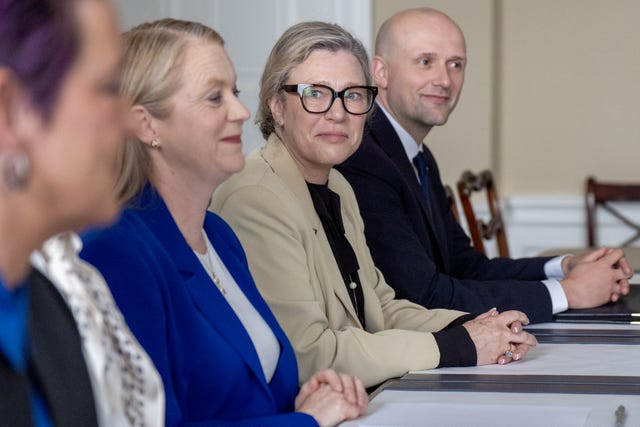
Gillian Martin reacted to figures which showed the country’s greenhouse gas emissions falling by 1% in 2024 – half the rate of the year before.
Scotland’s climate emissions have fallen but progress has continued to slow down, figures show.
Climate Action Secretary Gillian Martin said it was “disappointing” to see a reduction of only 1% in 2024 – half the rate of the year before.
Environmental campaigners described the figure as “meagre” as they accused the Scottish Government of failing to do enough to combat climate change.
The figures, released by the Scottish Government, show that since 1990 the country’s greenhouse gas emissions have reduced by more than half (50.5%).
Overall, Scotland produced an estimated 39.0 million tonnes of carbon dioxide equivalent (MtCO2e) from the seven greenhouse gases in 2024 – a reduction of 0.4 MtCO2e from the year before.
Most parts of the economy showed modest reductions in emissions, with industry seeing the largest at 0.3 MtCO2e due to a reduction in fuel use.
International aviation and shipping increased by 0.2 MtCO2e and have now returned to pre-Covid levels.
Domestic transport and buildings also showed slight increases in the latest year. All other sectors showed slightly reduced emissions.

Stop Climate Chaos Scotland, which represents 70 civil organisations, said the figures were “stark confirmation” that action to tackle climate change has been “nowhere near strong enough or fast enough”.
Fraser Sutherland, the group’s coalition manager, said: “Climate change is already affecting people’s health and well-being, livelihoods and financial stability in Scotland, with more frequent storms, floods, droughts and wildfires wreaking havoc across the country.”
He added: “The clock is ticking if we want to halt the worst effects of planetary warming but there is still time. The new Scottish Government must now make climate action a priority.”
Claire Daly, head of policy and advocacy at SCCS member group WWF Scotland, said the statistics showed “yet again the lack of meaningful progress by the Scottish Government in getting to grips with cutting climate emissions”.
“We need more than just incremental steps. We need real action and real delivery,” she said.
Friends of the Earth Scotland’s Catrina Randall said the “meagre” reduction figures were a “missed opportunity” to improve the lives of Scots.
She said: “They mean ministers have failed to help more people move around by public transport and failed to fix homes so that they aren’t leaking energy and costing a fortune in bills.
“A meagre 1% change makes clear that the Scottish Government have not been treating dangerous planetary heating with either the urgency or the energy it requires.
“The new Parliament is an opportunity to recommit to climate solutions and deliver transformative action that can tackle the cost of living, boost our health and create long-term green jobs.”
The Climate Action Secretary said: “Scotland’s greenhouse gas emissions have fallen by more than half since 1990, and these latest figures show that trend continues, with a one per cent drop in 2024.
“While progress is being made, that transition must accelerate because climate action is not just about weather events, it is about making people’s lives better.
“Our recent climate change plan set out £42.3 billion in direct financial benefits for Scotland, with the thriving net-zero economy currently supporting around 105,000 jobs. It will also provide significant wider impacts, from warmer homes to better air quality and improved health outcomes.
“And that’s driven by a record £5 billion in Scottish Government funding – taking ambitious and co-ordinated action now towards achieving net zero by 2045 is an investment in Scotland’s future.”
Speaking at the Scottish Parliament later, Ms Martin admitted the 1% was “disappointing” and “is not what it should be”, before adding that the country “should be accelerating faster”.
Scottish Labour MSP Claire Baker said Scotland’s progress on reducing its carbon footprint was not the “result of intentional policy” but “too often has been a consequence of what is happening anyway”.
“At a time that progress should be going faster, progress is stalling, and the carbon footprint figure published today has actually increased,” she said.
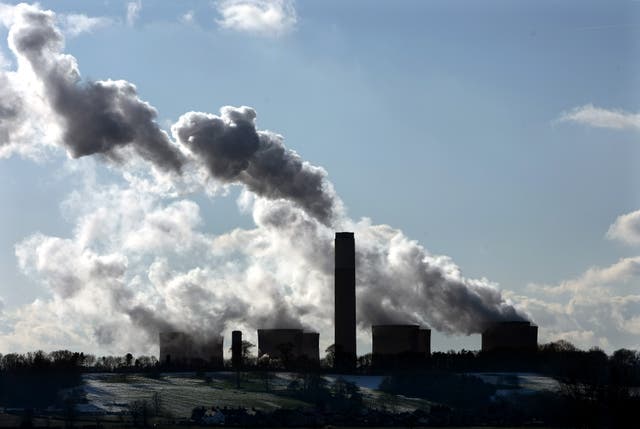
Reform UK Scotland MSP Duncan Massey said Scotland’s emissions only represent about 0.07% of global emissions, which he described as “a total rounding error”.
He said: “I massively disagree that this is an economic opportunity.
“Rather, it’s a massive economic cost for Scotland. It’s driving expensive energy, it’s driving de-industrialisation, and we’ve seen this with the closure of the Grangemouth refinery and with Mossmorran.
“Actually, we can see it in the figures of the report that the largest reduction, nearly 80% of it, came from reduced fuel use for combustion – that is basically industry closing down.”
Separate statistics released by the Scottish Government show Scotland’s carbon footprint between 2021 and 2022 increased by 1.6% from 60.0 to 61.0 MtCO2e.
These figures provide estimates of the country’s emissions associated with the spending of Scottish residents on goods and services, wherever in the world these emissions arise, together with emissions directly generated by Scottish households.
Between 1998 and 2022, Scotland’s carbon footprint fell by 17.5% from 73.9 MtCO2e in 1998 to 61.0 MtCO2e in 2022.
Jamie Livingstone, head of Oxfam Scotland, said: “Scotland’s rising consumption emissions are a warning light the Scottish Government can no longer ignore.
“Scotland cannot claim credit for marginally reducing overall emissions generated here while the pollution linked to the goods and services we consume from overseas continues to head in entirely the wrong direction.
“We would be cutting overall emissions far faster if we got a grip on consumption too.
“This new Parliament must mark the end of climate delay and drift. Scotland needs bold action to cut emissions fairly wherever they are produced, while investing in greener, warmer homes, clean transport, and making the better off and biggest polluters pay their fair share.”