ICRIR chief Sir Declan Morgan said the organisation had less than 50% of the resources it needed.
The body set up to investigate Troubles atrocities will have to consider all options if it does not get the funding it needs to carry out its work.
Independent Commission for Reconciliation and Information Recovery (ICRIR) chief Sir Declan Morgan said the organisation was in talks with the Treasury.
Appearing before the Stormont Executive Office scrutiny committee, Sir Declan also said they needed more powers and also co-operation from the Republic of Ireland to tackle their 123 case load, which included some of the most infamous bombings in the history of Northern Ireland.
ICRIR commissioner for investigations Peter Sheridan said the organisation was running at less than 50% of the resources it needed.
He also told MLAs that they had not received a response to any of the letters they had so far sent to the Irish Government requesting information.
The ICRIR was set up by the previous government’s Legacy Act after inquests into Troubles deaths were halted.
Sir Declan said initially in May 2024 they were at risk of being “completely overwhelmed”.
“I think there is no doubt that starting as we did, in the state of very limited preparedness that we were in, has cost us,” he told MLAs, recalling the length of time it had taken to vet staff and how the general election in July had set them back.
“We were thrown to the wolves, there was no space or resource… we had to wait months for the new government’s members to go through the vetting process and then we came back on to the track again.
“It was another factor that undoubtedly contributed to the fact that were in a powerless state for the first six months at least of the organisation.”
Sir Declan described an ongoing discussion with the Treasury as “vital”.
“If we end up in a situation where we have half the resource that we need to do the job, we are in trouble,” he said.
“That’s why the discussion that is ongoing at the moment between ourselves and the sponsoring department, the Treasury, is absolutely vital for us.
“If that doesn’t work out, I will be back (at committee) in relation to what exactly we would do in those circumstances because maybe we would have to think about the temporary closure of the organisation in terms of accepting new receipts – all options would be open at that stage.”
Sir Declan told MLAs they had 123 investigations ongoing, which he said was more murders than the Metropolitan Police in London had in the course of a year.
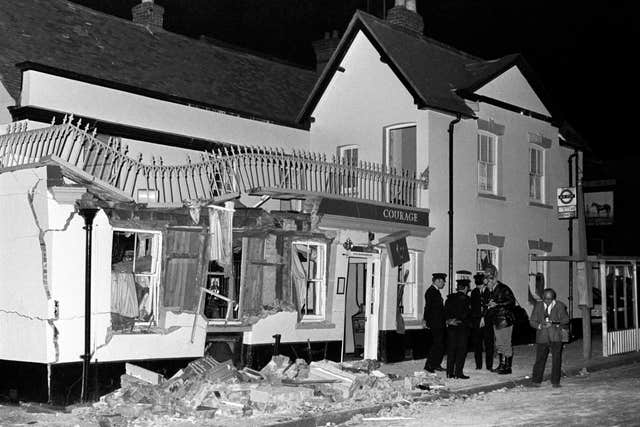
These included investigations into the Guildford pub bombings, in which five people were killed, on October 5 1974, as well as the killing of Judge Rory Conaghan on September 16 1974, and the killings of 18 soldiers and one civilian at Narrow Water in August 1979.
Sir Declan said the Guildford case was part of a series of events over a certain period, with eight to 10 linked cases that needed looking at, and would require at least five years of investigation due to complexity.
He said other cases with less complexity should not exceed two years.
Sir Declan told MLAs that four cases had “completed their investigative process” and had “moved to findings”.
“Three of them on April 1 this year, findings completed its work on the first of those cases on June 2, and the case is now in the representations process,” he said.
“We expect that two of the remaining cases will be through to the representations process by the end of August, and the fourth by the end of September.
“Our target is to be in double figures of reports before the end of this calendar year, and we would expect then to be moving much more quickly in the following calendar years after that.”
Mr Sheridan referred to “extensive intelligence and state material”, including 44 million documents held by the PSNI, amid “political and family scrutiny”.
“Sometimes, I don’t think there is an understanding of the scale of the work that we’re being expected to do,” he said.
“And we’re still running less than 50% of the resources needed to do this.”
DUP MLA Deborah Erskine said for the ICRIR to have cost £60 million to date but for no cases to have been completed “seems a large figure”.
She asked how “big of a block” the lack of co-operation from the Irish Government was, describing it as “heaping trauma upon innocent victims”, such as the families of those killed in the Provisional IRA’s bombing of Enniskillen in 1987.
Sir Declan said there were cases that had not come to the ICRIR because they were aware that Ireland “hasn’t yet committed to providing the information”.
“The present position is that Ireland is not providing us with information in relation to investigations,” he said.
“What we want, in order to make this work, is what we have with other agencies… a disclosure protocol.
“That’s what we want the arrangements with Ireland to lead to, that there is the same kind of approach towards disclosure so that we can get the information.”