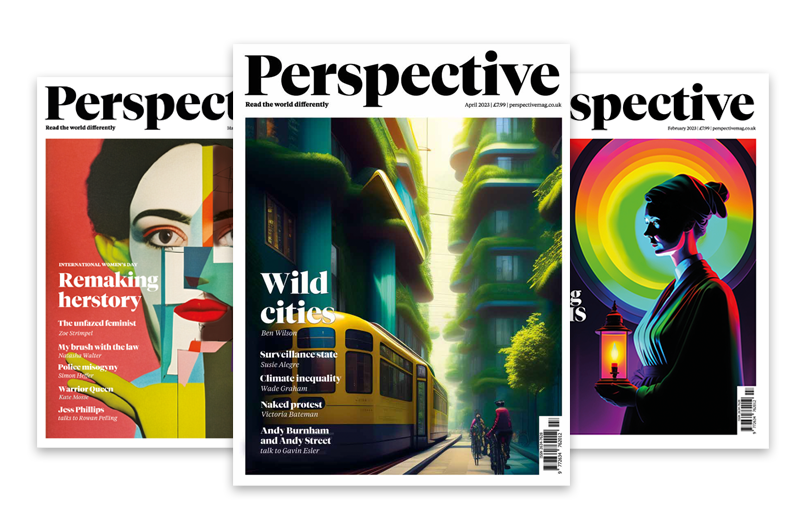
One defining feature (or so we hope) of Perspective’s quest to track down the most compelling stories is our commitment to gender parity. As a woman and a man co-editing these pages, we’re united in our belief that great writing is great writing – whether it arrives under the name of Currer Bell or Charlotte Bronte.
So, why are we bringing out our third International Women’s Day issue? The short answer is because in many parts of the world there’s still a terrifying lack of equality between the sexes. While it may be true that a privileged segment of Western women have never enjoyed so much personal autonomy – as Zoe Strimpel argues in one of our main essays – those in other countries are seeing their rights eroded, as the Woman Life Freedom movement in Iran has demonstrated.
But no nation currently ranks lower than Afghanistan in terms of women’s rights. It comes last in the 170 countries on the Women, Peace and Security Index (statistics gathered by Georgetown University and Oslo’s Peace Research Institute) and shows among the highest for gender-based violence against women. The situation for its female citizens has rapidly declined since the withdrawal of US and UK troops and the toppling of the Afghan government in August 2021. Under the restored Taliban regime, half the nation’s citizens are denied equal rights and even, from age eleven, an education.
That is why we sent Lipika Pelham to interview the inspiring Afghan journalist Zahra Joya, a London-based refugee who risked her life to establish a network of female journalists in Afghanistan under the banner of Rukhshana Media, named for a young woman who was stoned to death in 2015. There’s a historic kinship of bravery between Joya’s continuing band of clandestine female reporters and the women undercover agents, described by Rick Stroud, who courageously operated behind enemy lines in Belgium during World War I.
There is another field of struggle in which women often discreetly lead the way: as custodians of Gaia’s green spaces and endangered species. Who better to tell this story in our cover feature than Keggie Carew, whose book Beastly chronicles the 40,000-year-old relationship between humans and other animals. Meanwhile, in his regular column, Wade Graham pays homage to the brilliant American biologist and conservationist, Rachel Carson, whose 1962 book Silent Spring alerted the world to the poisoning of the planet by manmade chemicals.
Bookended by Francesca Kay’s Journal, and Doon Mackichan’s Q&A, you’ll find compelling writing on subjects as diverse as sexism in the music industry, or the opposing sides of the “terf” debate. Elizabeth Sharkey remembers the Quaker women who advanced women’s freedoms in Britain long before the suffragettes, while Viv Groskop points out that it hasn’t all been progress since then, even in the West. Channel 4’s Cathy Newman attests to misogynistic abuse in the media when she discusses her new book The Ladder. And women can themselves continue sexist tropes around beauty, as Joan Harrison writes from Hollywood.
Of course, it was the leading lights of second-wave feminism, such as Nancy Friday, Erica Jong and Gloria Steinem who first took the women’s movement into the more intimate and personal sphere of the body. Perhaps none of these pioneers had more impact than the enigmatic Shere Hite: as Suzanne Moore explains in our Reputations column, her report on women’s pleasure was considered so subversive it saw her “cancelled” long before that term had been adopted. Female sexual pleasure is a theme picked up by Rowan on the penultimate page, where she strives as ever to give this issue a happy ending.
Rowan Pelling & Peter Phelps