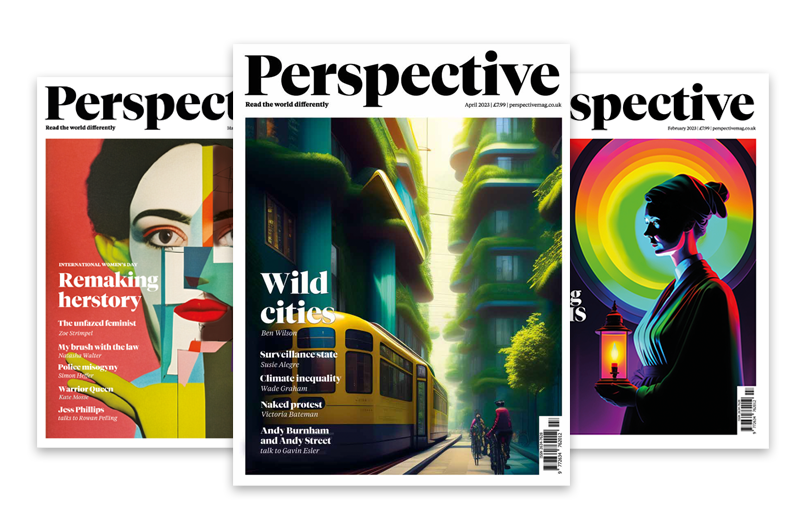
The coronation of Charles III is dominating headlines as Perspective goes to press, but in this issue we wanted to look beyond the focus on one man and consider the wider question of identity. To borrow from the BBC’s series about forebears and foundation stories: who do we think we are? For many of us, this has become a vexed question as old political, social and religious certainties have continued to dissolve. The discussion around transgender rights has become increasingly strident, adding to the strain caused by bitter arguments over Brexit and pandemic lockdowns, both of which saw many at loggerheads with, or even estranged from, friends and family members.
Of course, that’s all before we consider the angst surrounding how – as members of the various nations that make up an increasingly disunited UK – each of us identifies in the national sense. Arguably, no one knows better than Scotland’s Labour leader, Anas Sawar, the tension caused by the complex strands of British DNA being pulled tight: those that bind, and those that wrench us apart. In his interview with Gavin Esler, he talks of how he sees the notion of identity both enriching our society and being used to artificially foster division. Meanwhile, our cover story writer, Sydney Nash, casts light on how the stain of our history as global colonisers weighs heavily on the modern sense of Britishness. It’s a sentiment poignantly echoed by Irenosen Okojie in this month’s Journal.
Simon Heffer’s sense of Englishness is rooted in the village green traditions of Essex. But for our two Northern Irish writers, Kate Devlin and Róisín Lanigan, there’s a greater sense of self to be gained from finding your online “tribe” than from the arbitrary statehood conferred by an accident of birth. This reminds us that the question of individual identity is not only very complex, but often highly personal. For Yasmin Azad, who delves here into the association between our sense of connectedness and mental health, the answer might lie in the Asian-Muslim roots that bind her to an extended family. But Diana Thomas, whose identity is intricately linked with her experiences as a trans woman, believes we are more than the sum of our externalities, none of which really count for much in the greater scheme of life and death.
Of course, tribalism can also be just another word for what Cosmo Landesman elegantly describes in his Viewpoint as the “cacophonous clash” of polarised camps slagging each other off. For us as editors, the aim of creating stimulating discussion and debate on the pages of Perspective is to encourage cohesion, rather than its opposite. Arguments can be a natural and healthy part of any relationship – even our own editorial one! – but its purpose should always be to bridge, rather than create, divides. As some of those fortunate enough to have both the time and the wherewithal to even consider these questions, we’re mindful of how growing inequality represents the deepest fissure in the social fabric. And when the coronation teapot has been put away, we all must return to the task of collectively extending a hand towards those on the margins of society.
Rowan Pelling and Peter Phelps,
Editors