Andrew Cannestra was injured in northern Finland in February 2020 while on a trip organised by McLaren Automotive Events.
A US neurosurgeon suffered a “very significant” brain injury in a crash during a snowmobile safari organised by a branch of McLaren, the High Court has heard.
Andrew Cannestra’s snowmobile crashed near Ivalo, northern Finland, on February 2 2020, during a four-night “Pure McLaren Arctic Experience” arranged by McLaren Automotive Events, and the Florida native is alleging the company was in breach of contract and negligent.
Barristers for the 54-year-old told the first day of a trial in London that Mr Cannestra and his then-partner, Kaitlin Mealor, were given a safety briefing, but this did not include information on the layout of the track or the emergency stop button and tether cord on the snowmobile.
The motorsports group is defending the legal action, with its lawyers saying there was “no evidence” that the briefing did not meet safety standards and that the “irreducible risk” of the activity was “reasonably controlled”.
Opening the trial on Wednesday, Neil Block KC, for Mr Cannestra, said his client and Ms Mealor were “absolute novices” on snowmobiles, and that “a duty was owed by McLaren to use reasonable care”.
He said that while Mr Cannestra’s case was not “that the track was inherently unsafe”, he and Ms Mealor “did need to receive a proper and adequate briefing, and proper and adequate guiding”.
In written submissions, Mr Block said: “The briefing did not include any information about the layout of the track, the position of potentially hazardous bends, corners or other hazards.
“It seems to be McLaren’s case that this was not required.
“It is common sense that this was required, and the failure to do so must be a breach of duty.”
Mr Block told the court that Mr Cannestra and Ms Mealor’s “couples package” cost almost £24,000 before flights, with activities including driving a McLaren car on ice, and optional events such as snowmobiling.
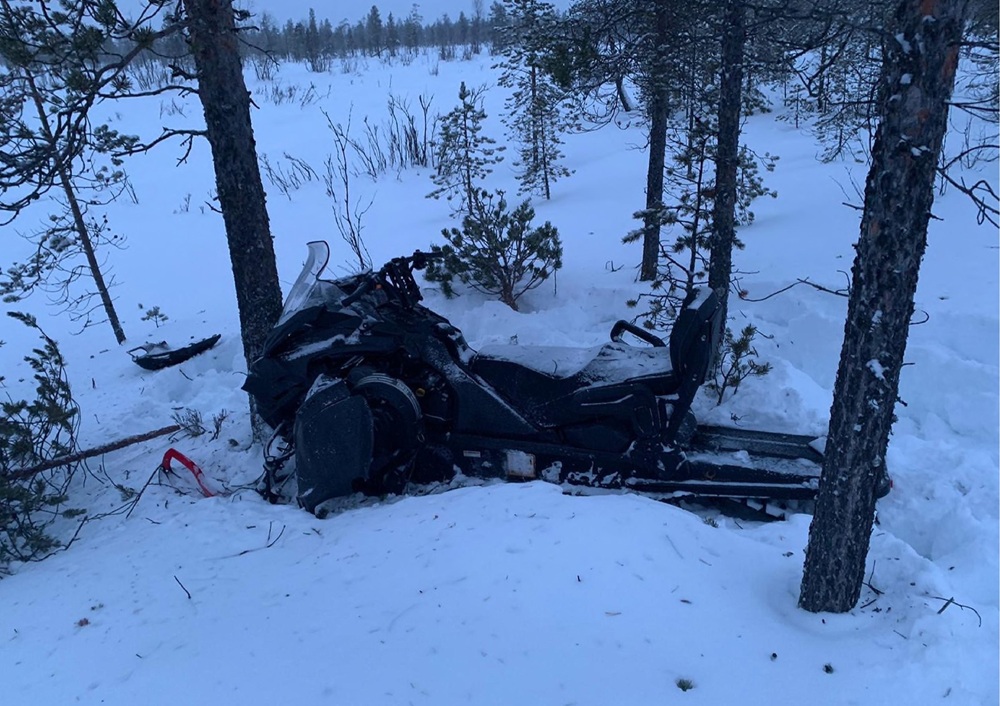
Mr Cannestra and Ms Mealor used a “dedicated snowmobile track” about four kilometres long, and signed a driver declaration, a waiver and a self-liability form beforehand.
They were given a safety briefing by two guides – Arto Pitkanen and Jouni Satta – which Mr Block said lasted “approximately five minutes”, with the barrister adding: “There is an issue about what it actually included.”
Mr Block said the Lynx Xtrim 900 snowmobiles had three modes – eco, standard and sport – with the tour beginning in eco mode, which had a top speed of 40kph.
A few hundred metres into the activity, Mr Block said the group stopped, and Mr Pitkanen approached Mr Cannestra and changed the mode, which increased its top speed and was “not appropriate”.
Mr Pitkanen is alleged to have then set off at speeds of up to 60kph, causing Mr Cannestra to lose sight of him and speed up as he “did not want to be on his own”, Mr Block said.
Mr Cannestra then lost control of the snowmobile on a bend, with the vehicle veering off the track into deep snow and hitting a tree, leaving him with a “very significant” brain injury and “orthopaedic injuries”.
Matthew Chapman KC, for McLaren, said in his written submissions that the turn where Mr Cannestra crashed was “quite safe if negotiated at an appropriate speed” and that the court “can confidently conclude that reasonable care and skill was exercised” in organising the outing.
He continued that Mr Pitkanen changed the snowmobile’s mode as Mr Cannestra was “eager” for this to happen and that he “explained the switch” to him.
He added that Mr Cannestra’s speed was “wholly within his control”, and claims that Mr Pitkanen had driven too far in front “cannot sensibly succeed”.
He said: “In this case, there was a well-organised, risk-assessed activity which was delivered by well-trained and experienced guides who complied with the local standard.
“The irreducible risk was, in other words, reasonably controlled.”
While acknowledging that the content of the safety briefing was “contentious”, Mr Chapman said it included the hand signal to stop, how to use the throttle and brake, starting the engine and “bodyweight shifting/leaning for turns”.
The trial before Mr Justice Ritchie, which is only dealing with the issue of liability, is expected to conclude this month, with a written judgment expected at a later date.