The Scottish First Minister and SNP leader spoke after face to face talks with Andy Burnham on Thursday.
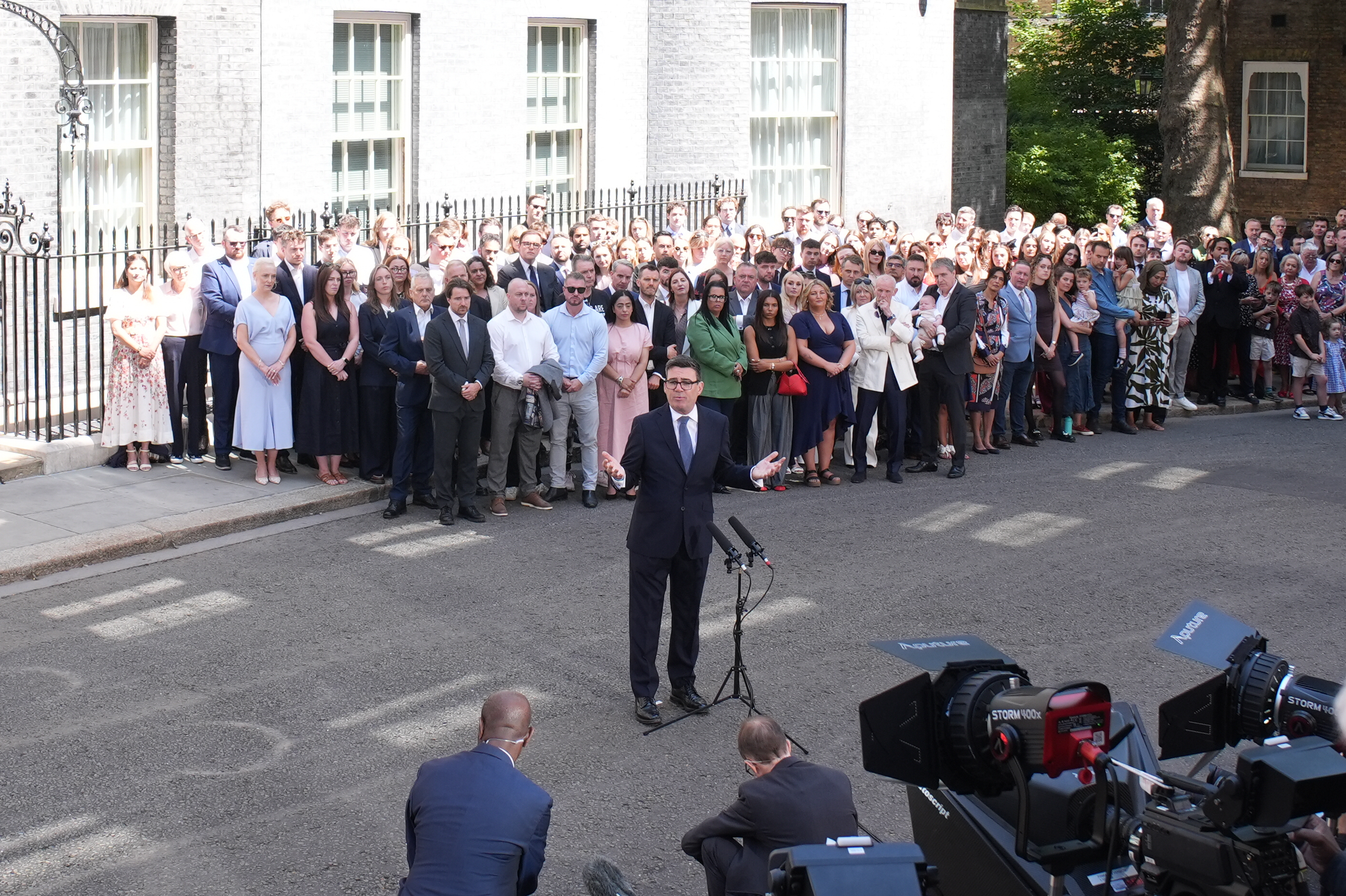
New Prime Minister Andy Burnham will “engage” with the Scottish Government on the possible devolution of further powers to Holyrood, John Swinney has said.
The SNP leader and Scottish First Minister said he had had a “constructive” first meeting with Mr Burnham, who had travelled to Glasgow for the opening of the Commonwealth Games.
Before the ceremony the Labour leader had his first face-to-face meeting with Mr Swinney since taking over from Sir Keir Starmer, as well as talks with the First Minister of Wales, Rhun ap Iorwerth.
Mr Burnham and Mr Swinney discussed devolution, and the two men are said to have “noted that there were a number of opportunities for the devolution of further powers to improve the lives of the people of Scotland and across the UK”.
Afterwards Mr Swinney told the Press Association they had “discussed the important question of the devolution of powers”.
The Scottish First Minister said: “The Prime Minister acknowledges and accepts that Westminster has failed many parts of the United Kingdom and has failed Scotland, and out of that comes a discussion about where powers should lie.”
He added: “He will engage with us on that question, and I welcome that.”
Before Thursday’s talks the UK Government had said Mr Burnham would set out how he plans to work “collaboratively” with devolved governments “based on a genuine partnership”.
The Prime Minister said: “I’m not focused on point scoring or discussing constitutional changes like referendums, I want practical measures to help people live well and bring back hope.”
In a telephone discussion earlier this week Mr Burnham made clear to the SNP leader they would have to “agree to disagree” on the issue of a second Scottish independence referendum.
Mr Swinney accepted that “the Prime Minister clearly does not agree with me on the question of independence” but he said had stressed “the importance of addressing the question of Scottish independence” in Thursday’s meeting.
May’s Scottish Parliament elections resulted in a record number of independence-supporting MSPs returned to Holyrood – though Mr Swinney’s SNP failed to win the overall majority he had wanted to push for a second ballot on the constitution.
Despite this he said: “The democratic question has got to be answered. I take that view and that is a priority for me to make sure it happens. The Prime Minister takes a different view.”
Mr Swinney also said he had “every confidence in the sincerity of the Prime Minister to take forward a constructive and collaborative relationship with the Scottish Government”.
The two leaders discussed what action could be taken to help people struggling amid the cost-of-living crisis, and Mr Swinney said there was a “brief mention of the controversial appointment” of Anas Sarwar to both Mr Burnham’s government and the House of Lords.
The former Scottish Labour leader led his party to its worst Holyrood election result just over two months ago.
Mr Swinney said: “I’m not going to discuss exactly the details of a conversation with the Prime Minister but let’s just say it is a topic of great interest to me, and great amusement, that a recent candidate for first minister finds himself in the House of Lords.”
A Downing Street spokesperson said afterwards: “The Prime Minister met the First Minister of Scotland, John Swinney, in Glasgow today, ahead of the start of the Commonwealth Games.
“The Prime Minister began by congratulating the First Minister and the city of Glasgow for hosting the Commonwealth Games, especially at short notice, and said he was looking forward to watching the opening ceremony later that evening.
“The conversation then turned to how the Prime Minister and First Minister can work more closely together to build a model of devolution to improve people’s lives across Scotland.
“The Prime Minister reiterated his belief that deeper devolution could make a real difference in helping communities across the UK to re-industrialise – creating jobs, transforming high streets and reviving local economies – and welcomed the First Minister’s willingness to engage with that process.”
The spokesperson added: “The Prime Minister stated up front that another referendum on independence was off limits because it would take our focus away from growing the economy and helping families with the cost of living.
“More broadly, the Prime Minister said this was a moment for both sides to work together in a constructive relationship. He looked forward to regular engagement with the First Minister in the months ahead.”