The US president has taken a conciliatory approach towards Vladimir Putin, while criticising the former British prime minister.
Former prime minister Sir Keir Starmer was “too tough” in his rhetoric towards Russia, President Donald Trump has claimed amid ongoing tensions between the Kremlin and allies of Ukraine.
Mr Trump also suggested recent warnings by European countries about the threat posed by Vladimir Putin were “too nasty”.
French President Emmanuel Macron said, last week, he had asked his government to draw up plans to safeguard critical infrastructure, including sensitive defence industry sites, against drone attacks and cyber attacks in the face of what he described as an intensifying Russian hybrid threat.
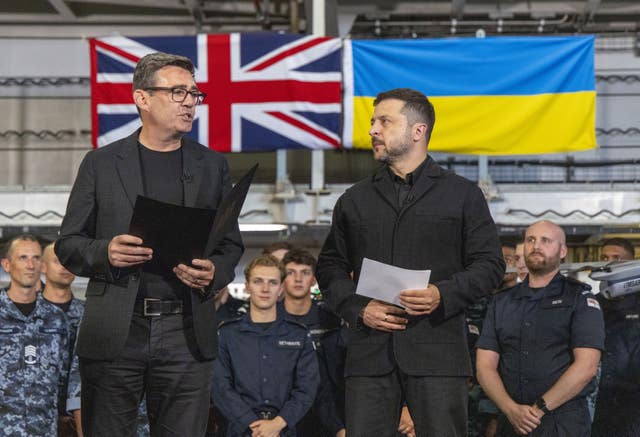
Since taking office, Andy Burnham has continued the policy of his predecessor, and that of other UK administrations, in pledging full support for the Kyiv government.
The Ukrainian leader Volodymyr Zelensky was the first foreign leader hosted by the Prime Minister after he arrived in Downing Street and his first official overseas trip was to the war-ravaged nation, where he announced Britain would provide the country with blueprints for long-range Scalp missiles, leading to threats of retaliation.
But ahead of this week’s meeting of the United Nations General Assembly in New York, Mr Burnham cautioned against “escalation” that could play into Russia’s hands.
Moscow has previously accused Ukraine’s supporters of “playing with fire”.
Asked during a meeting with Mr Zelensky at the UN about concern of a future conflict between the UK and Russia, Mr Trump said: “I think they’ll be OK, but I will say the rhetoric from your last prime minister was too tough. He has to be a little bit careful.”
On Mr Burnham, he added: “I haven’t heard the rhetoric too much, but I think he’s going to be good. I will say he’s on your side very much.”
The president had increasingly fractious dealings with Sir Keir, which worsened over the UK’s response to the Iran war.
He had earlier acknowledged this when he said relations between the two countries were now “more up” with Mr Burnham in charge rather than Sir Keir.
With growing warnings in Europe of the risk of attack by Moscow, Mr Trump said: “I’ve seen that dialogue, and that dialogue is too nasty.”
Since returning to the White House, Mr Trump has taken a conciliatory approach to his Russian counterpart while voicing criticism of traditional allies.
Earlier this month, he insisted Mr Putin was “not looking to attack Nato territory”, despite an attempted drone strike on a German airport that European countries, including the UK, blamed on Moscow.
The reluctance by the president to condemn the Kremlin raised further questions over Washington’s commitment to the long-standing military alliance and its key principle of collective security.
In response, the UK Government summoned a senior Russian diplomat to protest against the “egregious and reckless attack” at Leipzig airport.
The airport is a major international freight hub used for providing support to Kyiv, which has been battling invading Russian forces for more than four years.
While the Kremlin denied involvement, Germany said it was part of a pattern of “Russian hybrid operations” and Brussels said it had “all the hallmarks of state-sponsored terrorism”.
It was seen as part of a wider, continuing campaign of sabotage and disruption by Moscow with the aim of undermining support for Ukraine and causing wider instability and unrest.
Last week, the head of Royal Navy, General Sir Gwyn Jenkins, said that Moscow posed “the greatest threat to our security today” and was constantly “probing” the UK for weakness, particularly its vital undersea cables.
Speaking at the UN, Mr Trump said both Russia and Ukraine wanted to see the war between them end.
He said: “I think we’re going to make a deal.”
The president also said the US was discussing allowing Ukraine to produce Patriot interceptor missiles to help defend itself against Russian attacks.
Mr Zelensky has urged Washington to supply more of the weapons, but defence experts say there is currently a global shortage due to the Middle East conflict.