The Foreign Secretary was asked by reporters about the pro-democracy campaigner’s detention during her two-day trip to China.
Yvette Cooper vowed to continue raising the case of imprisoned British citizen Jimmy Lai with the Chinese government amid opposition calls for her to secure his release by Beijing.
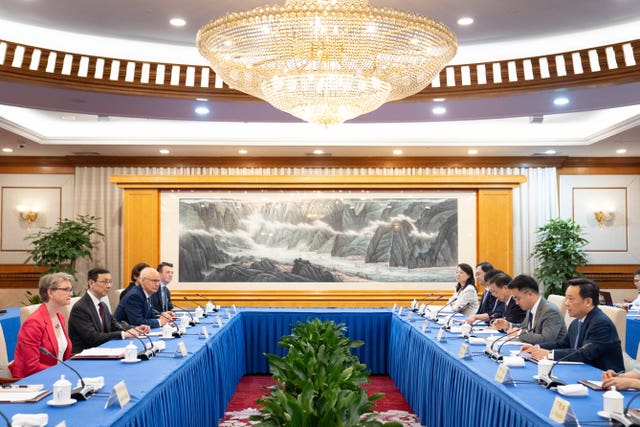
The Foreign Secretary said a “really important” working relationship had been established between the UK and China after years of frosty relations as she capped a two-day visit to the country.
But she has faced pressure to take a harder line with Beijing over concerns about national security and human rights issues, including the detention of pro-democracy campaigner Mr Lai.
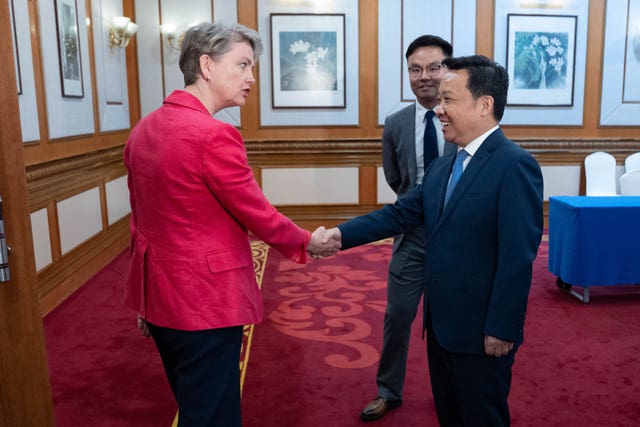
Asked whether she had insisted on his release and how firmly she had pressed his case in talks with her counterpart Wang Yi, Ms Cooper told the Press Association: “I have raised this and will continue to raise Jimmy Lai because this is a very important case to us.
“Our case remains we want to see his release as soon as possible, he’s a very elderly man.
“And I will be talking to his family and will continue to talk to his family.”
Sir Keir Starmer’s Government has also faced calls to challenge Beijing more forcefully on the reported human rights abuses against the Uighur Muslim minority in Xinjiang province.
Asked whether she had voiced objections to their plight, Ms Cooper said: “Yes, and I’ve raised freedom of religion as well.”
The UK Government sees engagement with the world’s second-largest economy as key to protecting Britain’s security in a period of heightened global volatility, but has insisted it will challenge Beijing where it must.
Meeting Chinese vice-president Han Zheng for talks on global security in Beijing’s Great Hall of the People on Tuesday, Ms Cooper had said the “international rules-based order” was in London and Beijing’s “shared interest”.
Asked whether she believed China was respecting that order, she said on Wednesday: “China is a member of the P5, the permanent five members of the (UN) security council, and we have to engage on these global security issues with China.
“We’ve talked about the importance of the rules-based international order – so too has China.”
She said there were “many areas where we have shared interests”, including on freedom of navigation in the Strait of Hormuz as Iran maintains its chokehold on the shipping lanes.
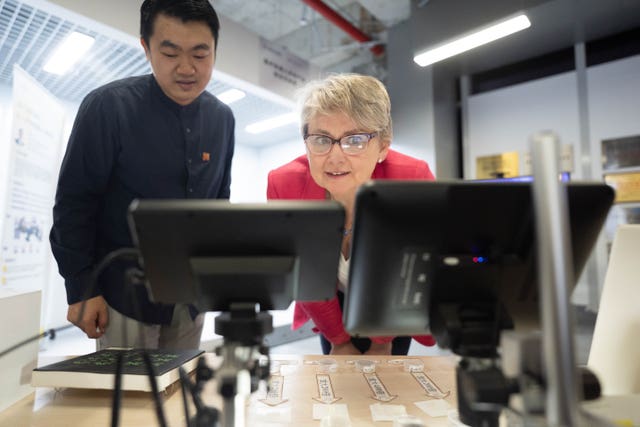
Following a day of bilateral talks in Beijing, Ms Cooper flew to Shenzhen, a major technology hub, where she met the city’s party secretary Jin Lei and toured a laboratory of the Institute of Artificial Intelligence and Robotics for Society, where she was shown how the technology was being used in healthcare and power grids.
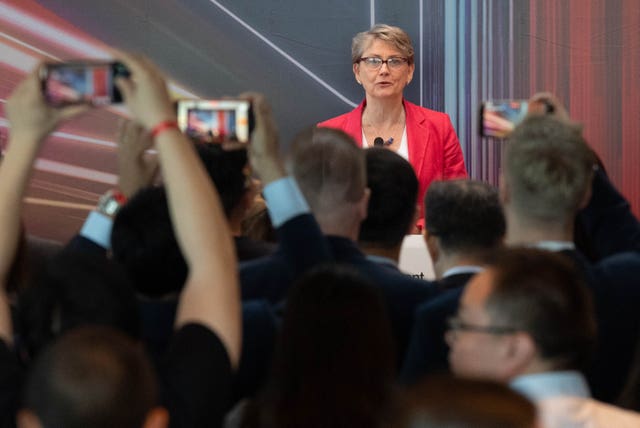
She said she had raised safety issues surrounding AI in her talks with both Mr Wang and Mr Han and sought to make the case for global standards safeguarding the development of the technology involving the United Nations.
Following the talks, she said: “What I want to see is global standards on AI security and safety involving the United Nations.
“I think this reflects the approach we’ve taken over very many years on nuclear security, where we have international nuclear standards.”
“Nuclear standards is an area where historically we worked with China as well as with other countries on standards. We had differences of view, but also did have co-operation on those areas as well,” she said.
Ms Cooper travelled from Shenzhen to Delhi, in India, on Wednesday evening ahead of talks on global security, including escalation around Hormuz amid the Iran war, with figures including her counterpart Subrahmanyam Jaishankar, on Thursday.